

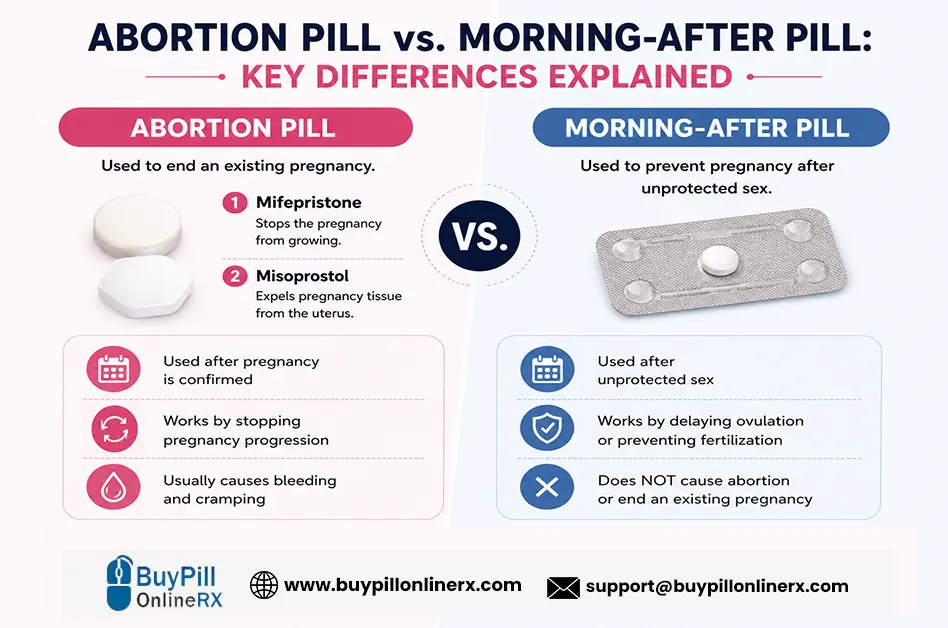
It is not uncommon for people to get confused between abortion pills and morning-after pills. This is because both medications are related to reproductive care and pregnancy. However, abortion pill vs morning-after pill are different in many aspects such as their purpose, action mechanism, timing, ingredients, dosage, and more. In this blog, we will take you through the difference between abortion pill and morning-after pill in detail.
What Is the Morning-After Pill?
Here is more about morning-after pill uses and other information:
· Purpose of the Morning-After Pill
The purpose is to work as emergency contraception, granting protection against getting pregnant after an unprotected sexual intercourse or a failed birth control. The objective is to give people the freedom of avoiding an unintended pregnancy from ever materializing.
· How It Works
Understanding how emergency contraception works creates the foundation of differentiating the morning-after pill from the abortion pill. The emergency contraceptive prevents ovulation so that a mature egg is not released by ovaries, or fertilized by sperm. But it does not end a pregnancy if it is already existing (successful implantation).
· Common Types
You can take either Levonorgestrel tablets such as Plan B (effective when used within 3 days or 72 hours of unprotected intercourse) or the non-hormonal Ulipristal acetate tablets (effective up to 5 days or 120 hours following the unprotected intercourse).
What Is the Abortion Pill?
Get the essential abortion pill information by reading ahead:
· Purpose of the Abortion Pill
The medicines, Mifepristone and Misoprostol are used to end an early pregnancy non-invasive. It is suitable for only intrauterine pregnancies and not ectopic pregnancies. You can use abortion pills at home by following physician’s recommendations and dosage instructions safely.
Unlike preventative measures, the abortion pill is a therapeutic medication protocol specifically prescribed to safely end an established, early-stage pregnancy. It is explicitly indicated for individuals who are already confirmed to be pregnant.
· How It Works
The primary pill, Mifepristone dislodges the pregnancy sections by shedding the endometrial lining. It puts a permanent stop to pregnancy by blocking the progesterone hormone. The second medicine, Misoprostol, causes uterine contractions via prostaglandin effect and widens the cervix. It expels pregnancy products through vaginal bleeding.
· Recommended Usage Period
As discussed, Mifepristone and Misoprostol pills are ideal for only early pregnancy termination i.e. if the pregnancy is within its first 10 to 12 weeks and no later. These pills are FDA-approved, and come with WHO guidelines for use in early conception only.
Abortion Pill vs Morning-After Pill – Quick Comparison Table
Here is a detailed view into difference between abortion pill and morning-after pill across all the essential aspects:
| Aspects | Morning-After Pill | Abortion Pills |
| Purpose | It prevents pregnancy from taking place. | It ends an early pregnancy that already exists. |
| When It is Used | Levonorgestrel tablets should be taken within 72 hours while Ulipristal acetate tablets within 120 hours of failed birth control or unprotected intercourse. | In the first 10 to 12 weeks of pregnancy (first trimester). |
| Active Ingredients | Levonorgestrel or Ulipristal acetate. | Mifepristone in the antiprogesterone pill, and Misoprostol in the prostaglandin medicine |
| How it Works | It suppresses ovulation for no mature egg to get released from the ovaries, thereby preventing risk of fertilization. | Mifepristone blocks progesterone to shed the uterine lining, while Misoprostol dilates cervix and leads to uterine contractions to flush out the pregnancy tissues. |
| Effectiveness | Best when taken within 24 hours of intercourse. But effective up to 72 hours or 3 days for Levonorgestrel. While Ulipristal acetate stays effective for up to 120 hours or 5 days. | Mifepristone and Misoprostol combination has 95-98% effectiveness in early gestation, while Misoprostol pills alone is effective for 85-95%. |
| Timing | Should be taken in 3 to 5 days after unprotected sexual intercourse or suspected failed birth control. | The pills can be taken up to 10-12 weeks of early pregnancy. |
| Prescription Requirements | Over-the-counter availability is there for Levonorgestrel, but Ulipristal is prescription-based. | May require a prescription depending on the healthcare provider and regional laws regarding medical abortion. But mostly ordered over-the-counter online by people. |
| Common Side Effects | Headache, dizziness, mild nausea, fatigue, menstrual cycle irregularities temporarily. | Heavy vaginal bleeding, nausea, vomiting, dizziness, chills, fever for a short time, severe abdomen cramps and pain, stomach upset, etc. |
| Follow-Up Care | You may not need one until there is no period even after a week of taking the medicine. | Usually, follow-up visit for pregnancy check via ultrasound is recommended after 2 weeks of the procedure. |
When Should You Consider Medical Advice?
When checking for emergency contraception vs abortion pill differences, you must also pay attention to instances where medical attention is required:
· If you soak 2 large pads or more every hour for 2 consecutive hours in medical abortion. This can signal excessive bleeding.
· If you have a high fever lasting more than a day, foul-smelling vaginal discharge, severe weakness, or fainting spells, then these are signs of sepsis, infection, or other complications.
· If severe abdominal pain does not reduce after taking the required pain relief medicines.
· If there is a delay in getting your period after a week of taking the emergency contraceptive tablet.
Common Myths and Misunderstandings
Here are the common misconceptions about emergency pregnancy prevention (morning-after pill) and medical pregnancy termination (abortion pill process):
· Is the Morning-After Pill the Same as an Abortion Pill?
Both these medicines are for different purposes. The morning-after pill prevents a pregnancy establishment by suppressing ovulation, whereas, the abortion pills end a confirmed intrauterine pregnancy within gestational limit of up to 12 weeks of conception.
· Can the Morning-After Pill End an Existing Pregnancy?
No, a morning-after pill cannot end a pregnancy that is already present. It does not contain the necessary properties and ingredients that would disrupt or discontinue an existing pregnancy.
· Are Both Medicines Used the Same Way?
A morning-after pill is meant to be taken as a single dose immediately after an unprotected intercourse (up to 72 hours in case of Levonorgestrel and up to 120 hours in case of Ulipristal acetate). But for medical abortion, Mifepristone 200mg is consumed orally on day 1. After 24 to 48 hours, Misoprostol 800mcg is administered buccally/sublingually/vaginally.
Choosing the Right Option Based on Timing
Knowing the distinctions of abortion pill vs morning-after pill, will help you arrive at the decision of using the right alternative based on timing:
· Take emergency contraceptive or morning-after pill, as soon as possible after unprotected intercourse, as the effectiveness is time sensitive for restricting ovulation.
· However, if a pregnancy occurs, then confirm the pregnancy location as well as gestational age. If it is up to 12 weeks of pregnancy and within the uterus, you can take Mifepristone and Misoprostol pills to self-initiate a home abortion.
Safety and Usage Precautions
Knowing the difference between abortion pill and morning-after pill also involves understanding the relevant safety and precautionary measures:
· Adhere to the dosage instructions and follow those strictly to get the best out of the medicines.
· Do not self-medicate without understanding the procedure, how to take the pills, and other safety protocols.
· Always verify the source from where you are obtaining the medicines. Make sure the pharmacy is reliable and offers authentic pills. If need arises, do consult a doctor for guidance.
Final Thoughts
The abortion pill vs morning-after pill shares different purposes. The former ends an existing pregnancy with Mifepristone and Misoprostol pills to be used for conceptions up to 12 weeks. The latter is used for emergency contraception to prevent a pregnancy occurrence, taken within a few hours / days following unprotected intercourse. You must seek information from reliable platforms to accurately understand about these pills, even look for professional guidance when necessary.
Frequently Asked Questions
Here are some common FAQs about abortion pill vs morning-after pill that would improve awareness:
1. Is the morning-after pill the same as the abortion pill?
A morning-after pill prevents occurrence of a pregnancy, whereas the abortion pill ends an early pregnancy after it comes into existence. Thus, both medicines are different from each other.
2. Can emergency contraception stop an existing pregnancy?
An emergency contraception cannot stop an existing pregnancy because it is designed only to prevent ovulation and thereby fertilization. However, an existing pregnancy means that fertilization and implantation are both in place, so morning-after pills won’t serve any purpose.
3. How soon should the morning-after pill be taken?
If you are using a Levonorgestrel tablet, take it within 72 hours but if you are using Ulipristal acetate, then take it within 120 hours of unprotected intercourse.
4. Can the abortion pill work after several weeks of pregnancy?
Yes, the medical abortion method is ideal for early pregnancy termination, up to 12 weeks of gestation.
5. Do both medicines cause bleeding?
The morning-after pill causes mild bleeding or spotting, somewhere like a withdrawal bleeding. However, the abortion pill results in heavy vaginal bleeding to vacate the uterus of all the pregnancy tissues.
6. Is a prescription required for these medicines?
Most morning-after pills are available over-the-counter as like the abortion pills. However, a prescription from a doctor may be required by some pharmacies and platforms. It is always recommended to seek proper medical advice before taking any of these medicines.